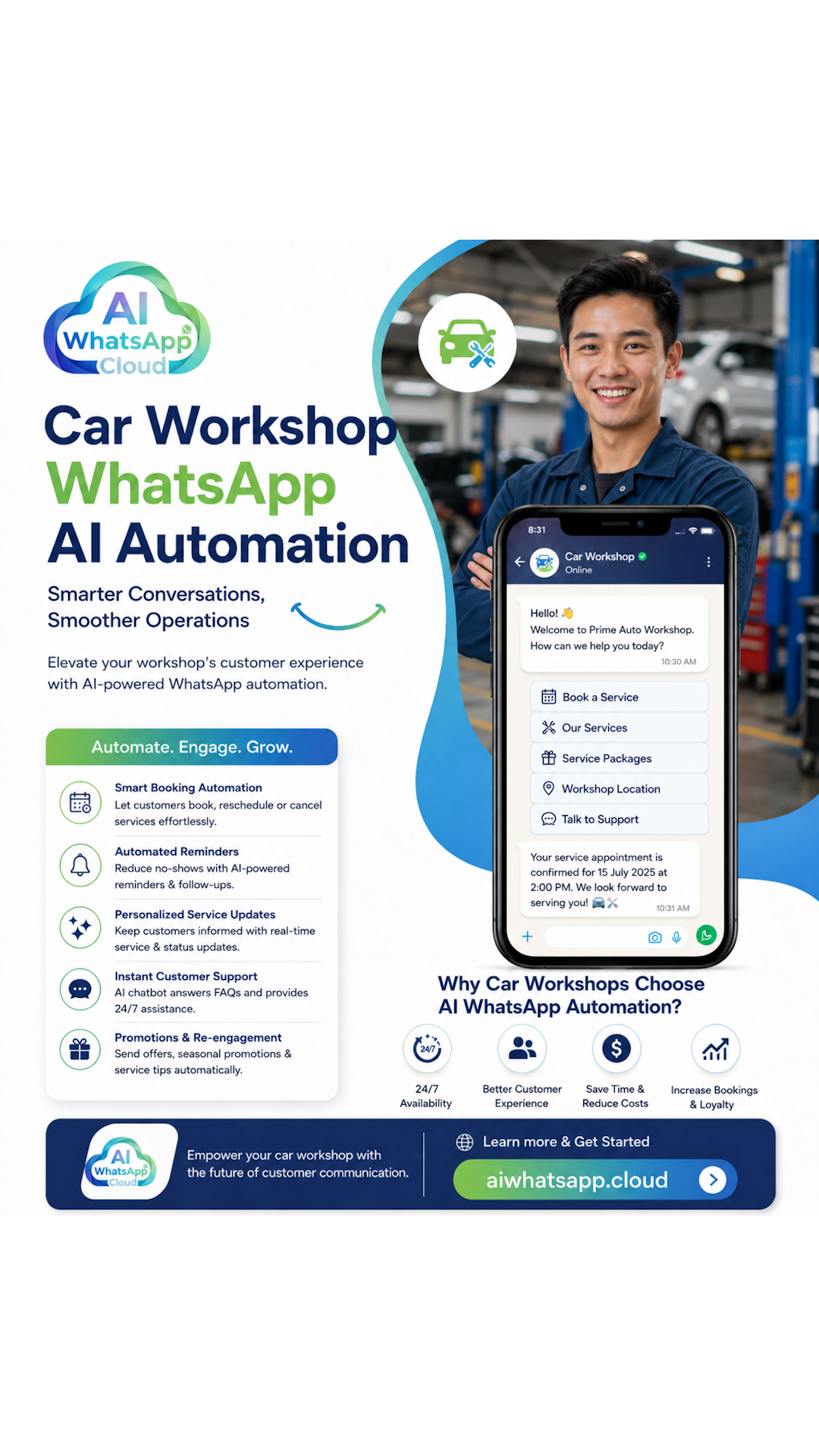
Malaysia Car Workshop WhatsApp AI Automation Case Study: Turning Vehicle Enquiries into More Service Bookings
For many car owners in Malaysia, the first step to finding a workshop is a WhatsApp message.
“Boss, how much to change brake pad?”
“Can I service my car this Saturday?”
“My aircond is not cold. Can check?”
For a Malaysia car workshop, these messages are part of everyday business.
The problem is that workshop teams are usually busy with vehicles, technicians, parts and customers at the service counter.
When dozens of WhatsApp enquiries arrive throughout the day, it becomes difficult to respond quickly and consistently.
This case study explores how WhatsApp AI automation can help a Malaysian automotive workshop manage customer enquiries, collect vehicle information and improve the journey from first message to service booking.
The Challenge: Too Many Customer Questions on WhatsApp
A typical Malaysian car workshop receives many different types of enquiries.
Customers may ask about:
- Car service prices
- Brake problems
- Tyre replacement
- Engine issues
- Car air-conditioning
- Battery problems
- Workshop availability
- Repair quotations
Many of these conversations start with very little information.
For example:
“My car got sound. How much?”
The workshop team then needs to ask several follow-up questions.
“What car?”
“What model?”
“What year?”
“What sound?”
“Can send video?”
This conversation may take many messages before the workshop even understands the customer's problem.
The issue is not that the customer is difficult.
The issue is that the initial enquiry is unstructured.
The Solution: A WhatsApp AI Assistant for Malaysian Car Workshops
The workshop introduced a WhatsApp AI automation workflow to handle the first stage of customer communication.
Instead of waiting for a staff member to manually ask the same questions, the AI assistant could guide the customer through a structured conversation.
For example:
“I can help you with your workshop enquiry. Is this for a service, repair or inspection?”
The AI could then continue:
“What is your car brand and model?”
“What issue are you experiencing?”
“Would you like to check available workshop slots?”
This creates a more organised conversation from the beginning.
How the WhatsApp AI Automation Works
1. Answers Common Workshop Questions
The AI assistant can respond to frequently asked questions about:
- General car servicing
- Brake inspection
- Tyre services
- Battery replacement
- Air-conditioning checks
- Workshop operating hours
- General booking procedures
The goal is not to diagnose every vehicle problem.
The goal is to provide useful first-level information and guide the customer towards the correct next step.
2. Collects Vehicle Information
Before a customer speaks to the workshop team, the AI can collect basic vehicle information.
For example:
- Car brand
- Car model
- Vehicle registration number
- Approximate vehicle age
- Current issue
This gives the workshop a clearer starting point.
Instead of receiving:
“How much for service?”
The team may receive:
“Customer owns a Perodua Myvi and wants to book a routine service next week.”
The conversation is immediately more useful.
3. Helps Customers Describe Vehicle Problems
Many car owners do not know the technical name for a vehicle problem.
They may say:
“There is a weird sound.”
“The car feels shaking.”
“Aircond sometimes cold, sometimes not.”
A WhatsApp AI assistant can ask simple follow-up questions using customer-friendly language.
For example:
“Does the sound happen when you start the car or while driving?”
“Does the vibration happen when braking?”
“Is the aircond problem worse when the car is stopped?”
This helps collect more useful information before the workshop team gets involved.
4. Handles Service Booking Enquiries
When a customer is ready to visit the workshop, the AI can collect:
- Preferred date
- Preferred time
- Vehicle information
- Service type
The customer can then be guided towards the next booking step.
This is especially useful for workshops that receive appointment requests through WhatsApp.
5. Follows Up on Repair Quotations
A common workshop challenge is quotation follow-up.
A customer may ask for a repair quotation and then stop replying.
The workshop team may not have enough time to manually follow up with every customer.
WhatsApp AI automation can help create a structured follow-up workflow.
For example:
“Hi, just checking whether you would like to proceed with the repair quotation discussed earlier. Would you like us to help arrange a workshop visit?”
This creates a more consistent follow-up process.
The Customer Journey Before WhatsApp AI Automation
Before automation, the process often looked like this:
- Customer sends a WhatsApp message
- Workshop staff are busy
- Customer waits for a reply
- Staff asks basic questions
- Customer replies several hours later
- Conversation becomes difficult to track
- Customer may contact another workshop
The workshop could lose a potential customer simply because the first conversation was too slow.
The Customer Journey After WhatsApp AI Automation
After introducing WhatsApp AI automation:
- Customer sends a WhatsApp enquiry
- AI responds immediately
- Vehicle and service information is collected
- Customer intent is identified
- Qualified enquiry is routed to the workshop team
- Staff continues the conversation with better context
The workshop team can focus on the actual service discussion instead of repeatedly asking the same basic questions.
The Business Impact
For a Malaysian car workshop, WhatsApp AI automation can improve several parts of daily operations.
Faster Customer Responses
Customers receive an immediate first response.
Better Enquiry Qualification
The workshop receives more useful vehicle and service information.
Less Repetitive Communication
Staff spend less time answering the same basic questions.
More Consistent Follow-Up
Quotation and service follow-ups can be managed in a more organised way.
More Opportunities for Repeat Business
Customers can receive structured service-related communication instead of disappearing after a single visit.
Why WhatsApp AI Automation Fits Malaysian Car Workshops
Automotive workshops are highly conversational businesses.
Customers often want to ask questions before they decide to book a service.
They may compare prices, describe a vehicle problem or ask whether a workshop can handle a particular issue.
This makes WhatsApp a natural communication channel for Malaysian automotive businesses.
The local workshop technology market is already focused on WhatsApp-connected workflows such as service reminders, appointment bookings, repair status updates and customer replies. This suggests that WhatsApp is not simply a marketing channel for workshops — it is increasingly part of the customer service workflow itself.
For a workshop handling many daily conversations, AI automation can help organise the first stage of that communication.
Final Thoughts
Running a car workshop in Malaysia requires more than repairing vehicles.
The team must also manage customer enquiries, bookings, quotations and follow-ups.
When every WhatsApp conversation is handled manually, repetitive questions can consume a significant amount of staff time.
With WhatsApp AI automation, a car workshop can respond faster, collect better vehicle information and create a more structured customer journey.
The AI handles the repetitive first conversation.
The human workshop team focuses on vehicle inspection, repair decisions and customer service.
For Malaysian car workshops, WhatsApp AI automation is a practical way to turn more customer conversations into organised service opportunities.
If you are a car workshop, auto service centre or automotive business looking to automate WhatsApp enquiries, visit AIWhatsApp.Cloud to explore how WhatsApp AI automation can support your customer communication workflow.
Recommended WhatsApp AI Articles
- Malaysia Dental Clinic WhatsApp AI Automation Case Study: Improving Appointment Enquiries and Patient Communication
- Malaysia Logistics WhatsApp AI Automation Case Study: Managing Delivery Enquiries More Efficiently
- Malaysia Pet Hotel WhatsApp AI Automation Case Study: Turning Pet Boarding Enquiries into Bookings