Malaysia Logistics WhatsApp AI Automation Case Study: Managing Delivery Enquiries More Efficiently
Industry: Logistics & Delivery
Market: Malaysia
Use Case: WhatsApp AI Automation, Delivery Enquiries, Shipment Communication
The Problem: Customers Keep Asking the Same Delivery Questions
A customer sends a WhatsApp message:
"Hi, where is my parcel?"
Another customer asks:
"Can you check my delivery status?"
A third customer wants to know:
"Why has my delivery not arrived yet?"
For a logistics company, these questions are normal.
The problem begins when the same questions arrive throughout the day across multiple WhatsApp conversations.
The customer service team has to manually read each message, check the relevant information and type a response.
When the number of enquiries increases, the process becomes difficult to manage.
This is where Malaysia logistics WhatsApp automation can help create a more structured customer communication workflow.
A Common Scenario for a Malaysian Logistics Company
Consider a growing logistics and delivery business in Malaysia.
The company handles regular customer enquiries through WhatsApp.
Customers want updates about their deliveries.
Business customers want to check shipment progress.
Some customers need help understanding a delivery status.
Others want to report a delivery issue.
The customer service team is responsible for handling these conversations.
At the same time, the team may also be managing internal operations and other communication channels.
The result is a familiar problem:
The team spends too much time manually answering repetitive delivery questions.
The Operational Challenge
The logistics company was facing several common WhatsApp communication challenges.
1. Repetitive Tracking Enquiries
Customers frequently ask about the status of a shipment.
The team must manually review each message and provide a response.
2. Delivery Status Questions
Customers may not understand what a particular delivery update means.
This creates additional conversations between the customer and the support team.
3. After-Hours Messages
Customers can send WhatsApp messages outside normal business hours.
The message may remain unanswered until the next working day.
4. Delivery Exception Conversations
A delayed delivery or failed delivery can generate additional questions.
The support team needs to manage the conversation and determine the next step.
5. Manual Customer Communication
The team repeatedly sends similar replies throughout the day.
Over time, this creates a significant amount of repetitive administrative work.
The Solution: WhatsApp AI for Logistics Enquiries
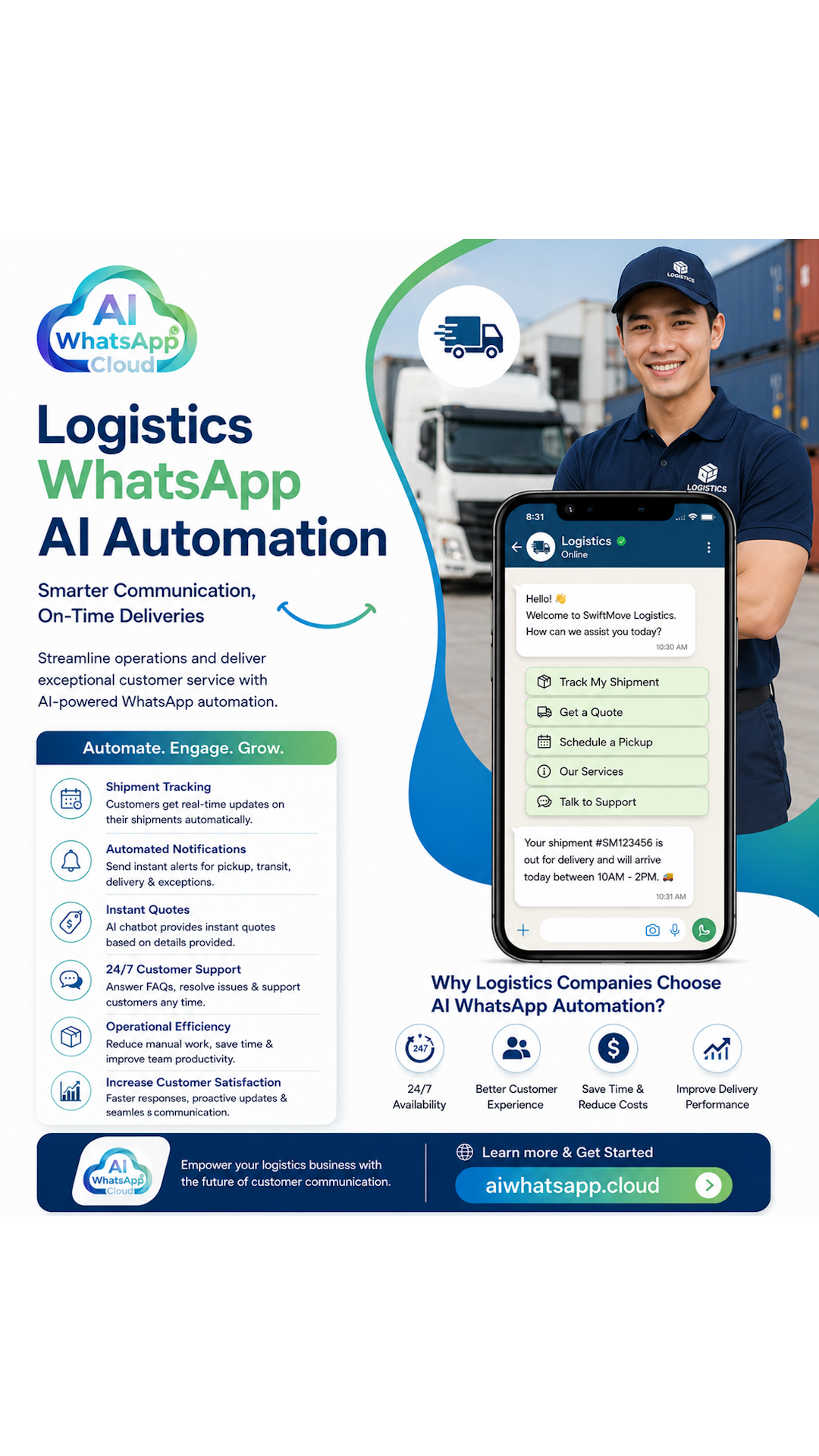
The logistics company introduced a WhatsApp AI automation workflow with AIWhatsApp.Cloud.
The objective was simple:
Create a more efficient first layer of customer communication.
The AI assistant was configured around the company's approved delivery information, common customer questions and communication workflows.
Instead of treating WhatsApp as a basic inbox, the company could create a structured process for managing incoming enquiries.
How the WhatsApp AI Logistics Workflow Works
Step 1: A Customer Sends a WhatsApp Message
A customer sends:
"Can you check my delivery status?"
The conversation starts naturally on WhatsApp.
The customer does not need to search for a phone number or wait for a customer service agent to become available.
Step 2: AI Identifies the Customer's Intent
The AI recognises that the customer is asking about a delivery or shipment.
This helps the conversation move toward the relevant workflow.
The AI does not need to treat every message as a completely new conversation.
Step 3: Common Delivery Questions Are Answered
Customers may ask questions such as:
"What does this delivery status mean?"
The AI can provide information based on the company's configured knowledge and approved responses.
This helps reduce the need for a team member to manually answer every basic question.
Step 4: The Customer Is Guided to the Next Step
If the enquiry requires additional information, the WhatsApp workflow can guide the customer through the required steps.
The goal is to make the conversation clearer.
Instead of sending a generic reply such as:
"Please contact customer service."
The workflow can help the customer understand what information is required next.
Step 5: Human Handover for Exceptions
Not every delivery issue should be automated.
If a customer has a complex delivery problem or requires staff assistance, the conversation can be handed over to the customer service team.
The AI supports routine enquiries.
The human team handles exceptions and situations requiring judgement.
Supporting Delivery Exception Communication
Logistics communication is not limited to standard delivery updates.
Some of the most difficult customer conversations happen when something does not go as expected.
For example:
- A delivery is delayed
- A recipient is unavailable
- A delivery attempt is unsuccessful
- A customer needs additional assistance
- A shipment requires human review
These conversations can create additional workload for the customer service team.
A structured WhatsApp AI workflow can help with the initial conversation.
The AI can identify the general intent of the customer and guide the conversation toward the appropriate next step.
If the situation requires human intervention, the conversation can be escalated.
What Changed for the Customer Service Team?
The main change was a clearer division of work.
WhatsApp AI Can Support:
- Common delivery questions
- Basic shipment-related FAQs
- Delivery status conversations
- Initial customer information collection
- Routine WhatsApp communication flows
Customer Service Staff Continue to Handle:
- Complex delivery problems
- Customer complaints
- Special shipment cases
- Operational exceptions
- Situations requiring human judgement
The objective is not to remove the customer service team.
The objective is to reduce repetitive conversations that do not always require manual intervention.
Why WhatsApp AI Automation Is Relevant for Malaysian Logistics Companies
For logistics companies, customer communication can become difficult to scale.
The number of deliveries increases.
The number of customer questions increases.
But the customer service team cannot always grow at the same speed.
This creates pressure on the support team.
Many customers also prefer to send a quick WhatsApp message instead of calling a customer service centre.
That makes WhatsApp an important part of the customer communication workflow.
The challenge is what happens after the message arrives.
If every delivery question requires a human to manually read, check and reply, the process becomes increasingly difficult to manage.
This is why WhatsApp AI for logistics and Malaysia delivery WhatsApp automation are becoming relevant for businesses that receive high volumes of routine enquiries.
The Key Lesson
A logistics company does not need to automate every customer interaction.
The best place to start is usually the repetitive conversations.
When customers repeatedly ask about delivery status, shipment information or common delivery questions, AI can help support the first layer of communication.
When the customer has a complex issue, the human team can take over.
This creates a more practical approach to automation.
Automate the repetitive work. Keep the important conversations human.
Final Takeaway
For Malaysian logistics and delivery companies, WhatsApp can become more than a customer messaging channel.
It can support a structured customer communication workflow.
With the right Malaysia logistics WhatsApp automation strategy, businesses can create a more consistent way to handle delivery enquiries, answer common questions and guide customers toward the next step.
AI does not replace the customer service team.
It helps the team spend less time repeating the same delivery information and more time focusing on complex customer situations.
AIWhatsApp.Cloud helps businesses build smarter WhatsApp AI workflows for customer enquiries, delivery communication and everyday business operations.
Explore WhatsApp AI Automation
Frequently Asked Questions
What is WhatsApp AI automation for logistics companies?
WhatsApp AI automation uses AI-powered conversation workflows to help logistics companies manage common customer enquiries and delivery-related conversations on WhatsApp.
Can a WhatsApp AI chatbot answer delivery questions?
Yes. A WhatsApp AI chatbot can be configured around approved company information and common delivery-related FAQs.
Can WhatsApp AI help logistics companies manage tracking enquiries?
WhatsApp AI can support tracking-related conversations and guide customers through the company's configured communication workflow.
Is WhatsApp AI suitable for Malaysian logistics companies?
Yes. Logistics businesses that receive frequent WhatsApp enquiries can use AI automation to reduce repetitive manual conversations and create a more consistent customer communication process.
Does WhatsApp AI replace logistics customer service staff?
No. The goal is to support customer service teams with routine enquiries. Complex delivery issues and exceptions can remain with human staff.