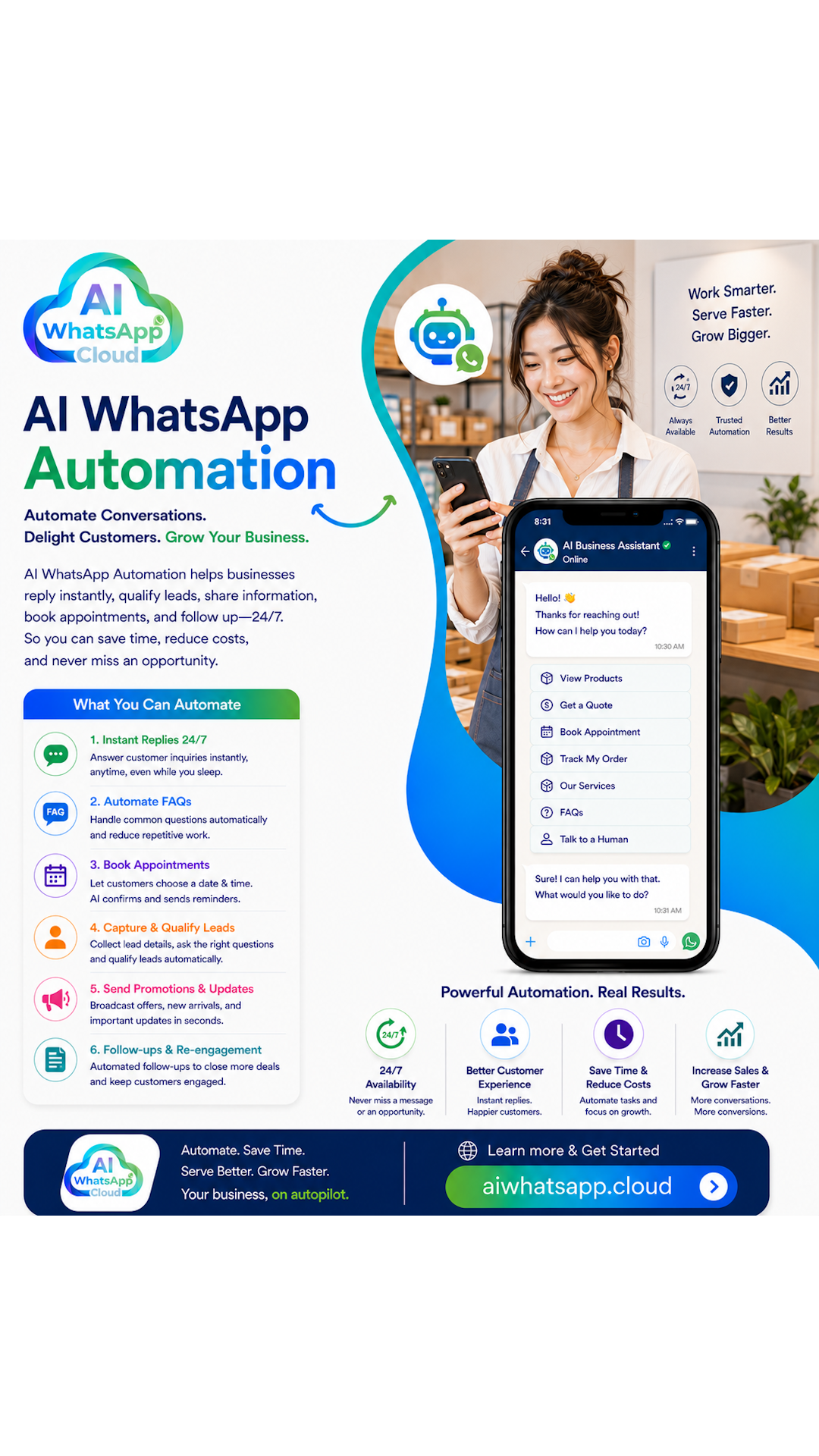
AI WhatsApp Automation: How Businesses Can Automate Customer Conversations and Scale Communication
For many businesses, WhatsApp has become one of the most important customer communication channels.
Customers send messages to ask about prices.
They ask about availability.
They request quotations.
They want to book an appointment.
They ask about delivery.
They need support.
The problem is that many businesses still manage every WhatsApp conversation manually.
A team member needs to read every message.
Type every reply.
Ask the same questions.
Follow up with the same leads.
And remember to reply to customers who sent a message hours or days ago.
This is where AI WhatsApp Automation can help.
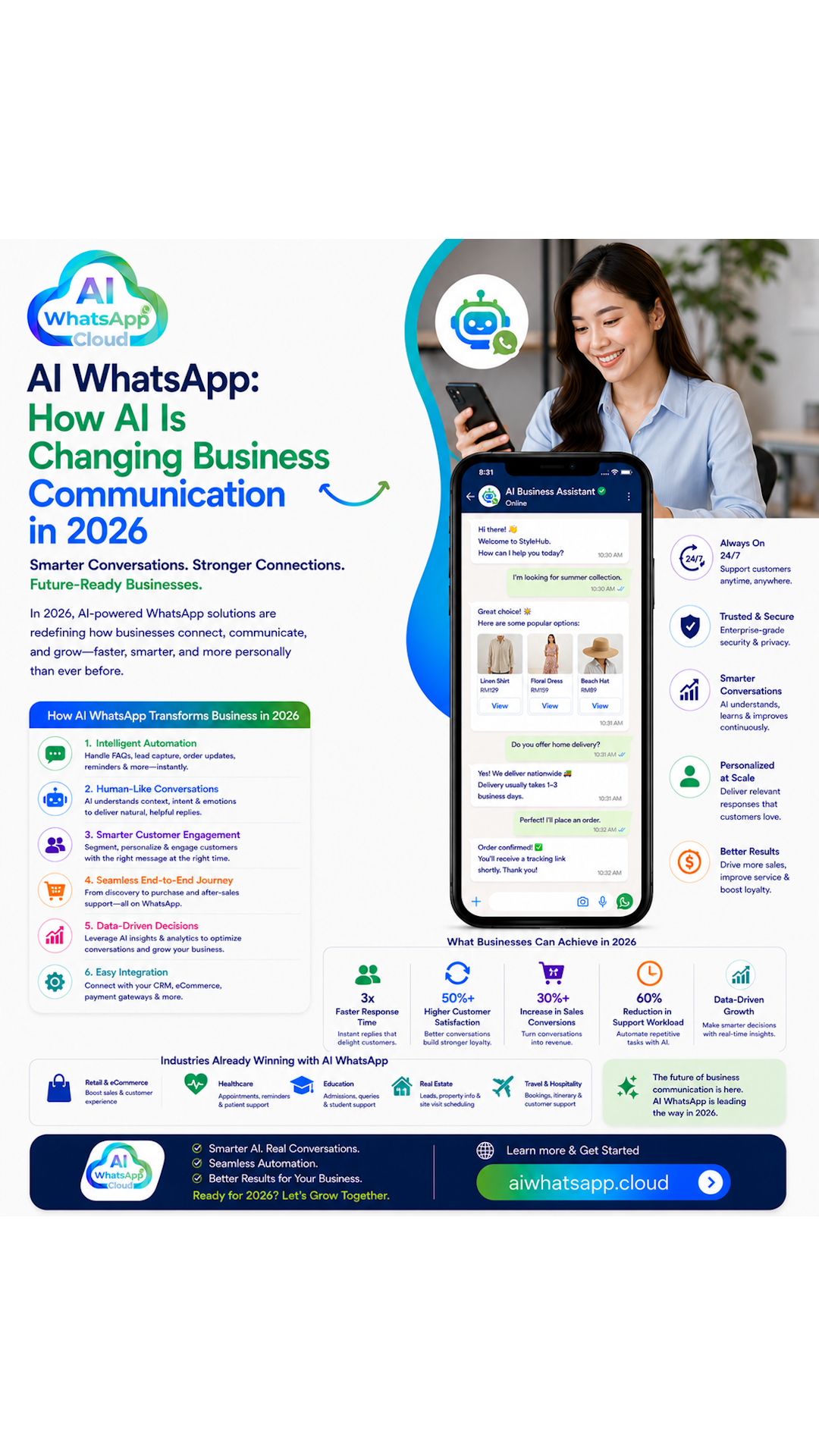
AI WhatsApp Automation allows businesses to use AI and automation to manage customer conversations more efficiently through WhatsApp.
Instead of treating WhatsApp as just a messaging application, businesses can turn it into an intelligent customer communication workflow.
What Is AI WhatsApp Automation?
AI WhatsApp Automation is the use of artificial intelligence and automated workflows to manage business conversations on WhatsApp.
An AI WhatsApp system can help businesses:
- Answer common customer questions
- Understand customer enquiries
- Qualify leads
- Collect customer information
- Handle booking enquiries
- Guide customers through a process
- Send follow-up messages
- Route conversations to the right team
- Escalate complex requests to human staff
The important difference is that AI WhatsApp Automation is not simply a collection of fixed replies.
A modern AI system can understand the context of a customer's message.
For example, a customer may write:
"Hi, I need to book something for next Friday. Do you have any slots?"
The AI can understand that the customer may be asking about availability and booking.
The conversation can then continue naturally.
Why Businesses Are Looking at AI WhatsApp Automation
Customer communication is becoming more demanding.
Customers expect fast responses.
They do not always message during office hours.
They may send a question at night.
They may send multiple messages before a staff member has time to reply.
For a business, manually managing every conversation can create several problems.
Slow Response Times
A customer may send a message in the morning.
The business may only reply several hours later.
By that time, the customer may have already contacted another business.
Repetitive Work
Many businesses answer the same questions every day.
"What is your price?"
"Where are you located?"
"Do you have availability?"
"What time do you open?"
"How do I book?"
This repetitive communication consumes valuable staff time.
Missed Leads
Some customer conversations are forgotten.
A staff member may reply to the first message but fail to follow up later.
The customer may be interested but never receive another message.
Growing Communication Volume
As a business grows, the number of WhatsApp conversations usually grows as well.
Hiring more people to answer repetitive questions is not always the most efficient solution.
AI WhatsApp Automation helps businesses approach the problem differently.
AI WhatsApp Automation Is More Than a Chatbot
Many business owners think of a chatbot as a system that replies to keywords.
For example:
Customer: "Price"
Bot: "Please visit our website."
This type of experience is limited.
AI WhatsApp Automation is designed to support a more natural conversation.
A customer can ask a question in their own words.
The AI can understand the intent.
The AI can provide a relevant response.
The AI can ask the next question.
This creates a more conversational customer experience.
The goal is not to force every customer to follow a rigid menu.
The goal is to make the conversation easier.
AI WhatsApp for Customer Enquiries
Most businesses receive customer enquiries every day.
Some enquiries are simple.
Some require more information.
For example, a customer may write:
"Hi, I want to know more about your service."
Instead of immediately sending a generic message, AI WhatsApp can continue the conversation.
The AI may ask:
"Sure. Are you looking for information about our pricing, services or booking process?"
The customer can reply naturally.
The AI can then guide the customer to the next step.
This helps businesses organise their initial customer conversations.
AI WhatsApp for Lead Qualification
Not every enquiry is the same.
Some customers are just asking a question.
Some customers are ready to buy.
Some customers need a quotation.
AI WhatsApp Automation can help businesses qualify leads during the conversation.
The AI can collect information such as:
- Customer name
- Type of service required
- Budget or requirements
- Preferred date
- Location
- Business needs
The exact questions depend on the business.
The benefit is that the sales team can receive better context.
Instead of receiving:
"Hi"
The team may receive a more complete enquiry.
For example:
"Customer is looking for a quotation for a 3-bedroom property and prefers to view this weekend."
This creates a more useful sales conversation.
AI WhatsApp Can Help Businesses Respond 24/7
Customers do not only send messages during office hours.
A potential customer may be searching for a service at 11pm.
A traveller may ask a hotel about a room late at night.
A patient may want to request an appointment outside normal working hours.
A business may not have staff available at that exact moment.
AI WhatsApp Automation can help provide an initial response.
The customer can start a conversation.
The AI can answer approved questions.
The AI can collect information.
The business team can continue the conversation when human assistance is required.
This helps businesses stay more responsive without requiring staff to manually monitor WhatsApp all night.
AI WhatsApp for Appointment Booking
Many businesses receive appointment requests through WhatsApp.
Examples include:
- Dental clinics
- Beauty salons
- Medical centres
- Service businesses
- Consultants
- Fitness businesses
A customer may write:
"I want to book an appointment next week."
AI WhatsApp can help guide the conversation.
The AI may ask for:
- Preferred date
- Preferred time
- Type of appointment
- Customer details
The business can then follow its own booking workflow.
This creates a more organised way to manage appointment enquiries.
AI WhatsApp for Sales Follow-Up
A customer may ask for a quotation.
The business sends the information.
Then the conversation stops.
This happens frequently.
The customer may still be interested.
However, the business may forget to follow up.
AI WhatsApp Automation can help businesses create follow-up workflows.
For example:
- Customer asks for information
- Business sends the relevant details
- Customer does not reply
- A follow-up workflow is triggered based on the business process
- The customer is reminded or re-engaged
Follow-up should always be designed around the business's communication strategy and applicable messaging rules.
The important idea is simple:
A customer conversation should not disappear just because the customer did not reply immediately.
AI WhatsApp Can Handle Frequently Asked Questions
Every business has repetitive questions.
An AI WhatsApp system can be configured around the business's approved information.
For example:
"What are your opening hours?"
"Where are you located?"
"Do you provide delivery?"
"What services do you offer?"
"How long does it take?"
Instead of requiring a staff member to type the same answer repeatedly, AI WhatsApp can assist with these common questions.
The staff team can focus on conversations that need human attention.
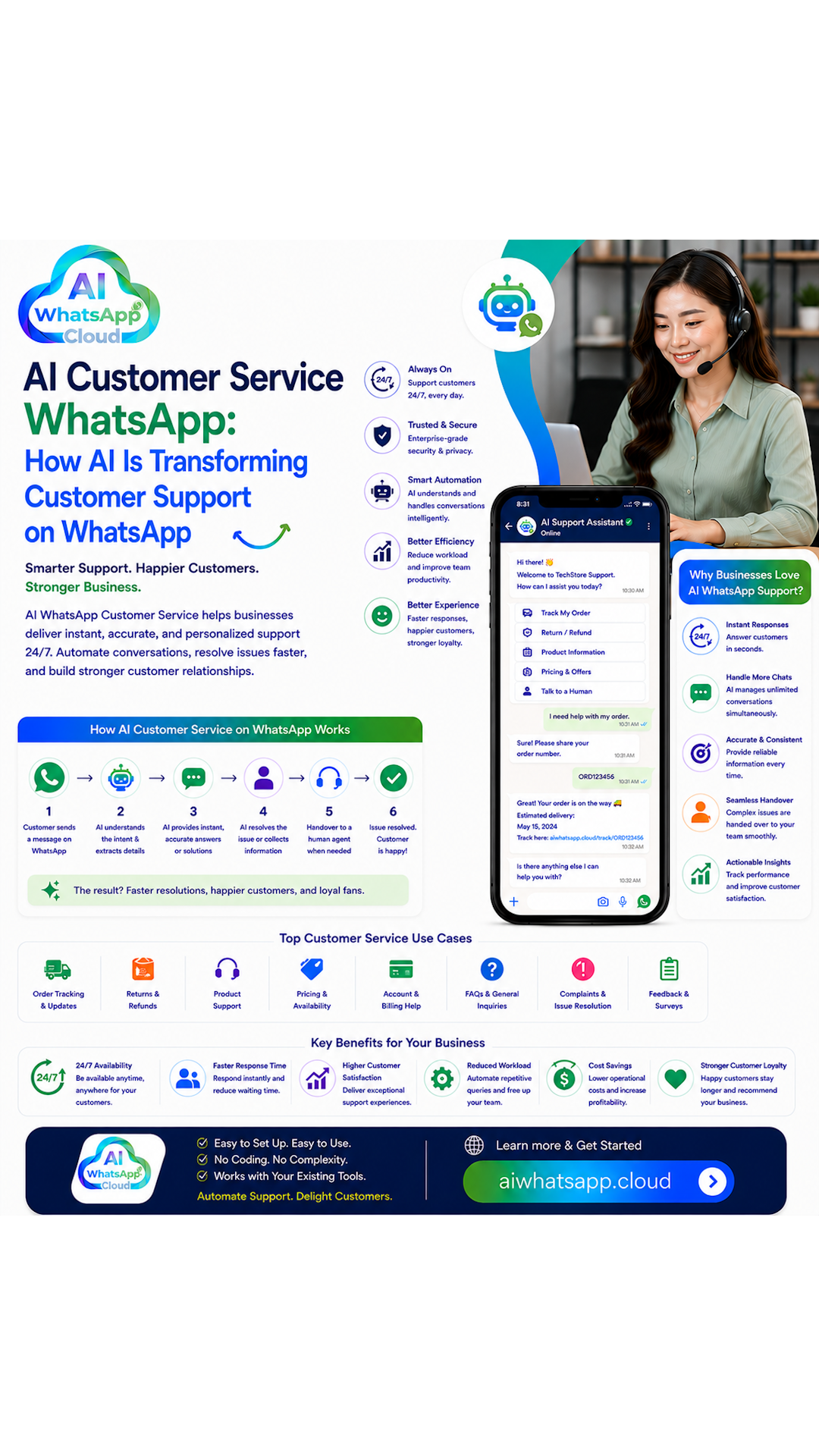
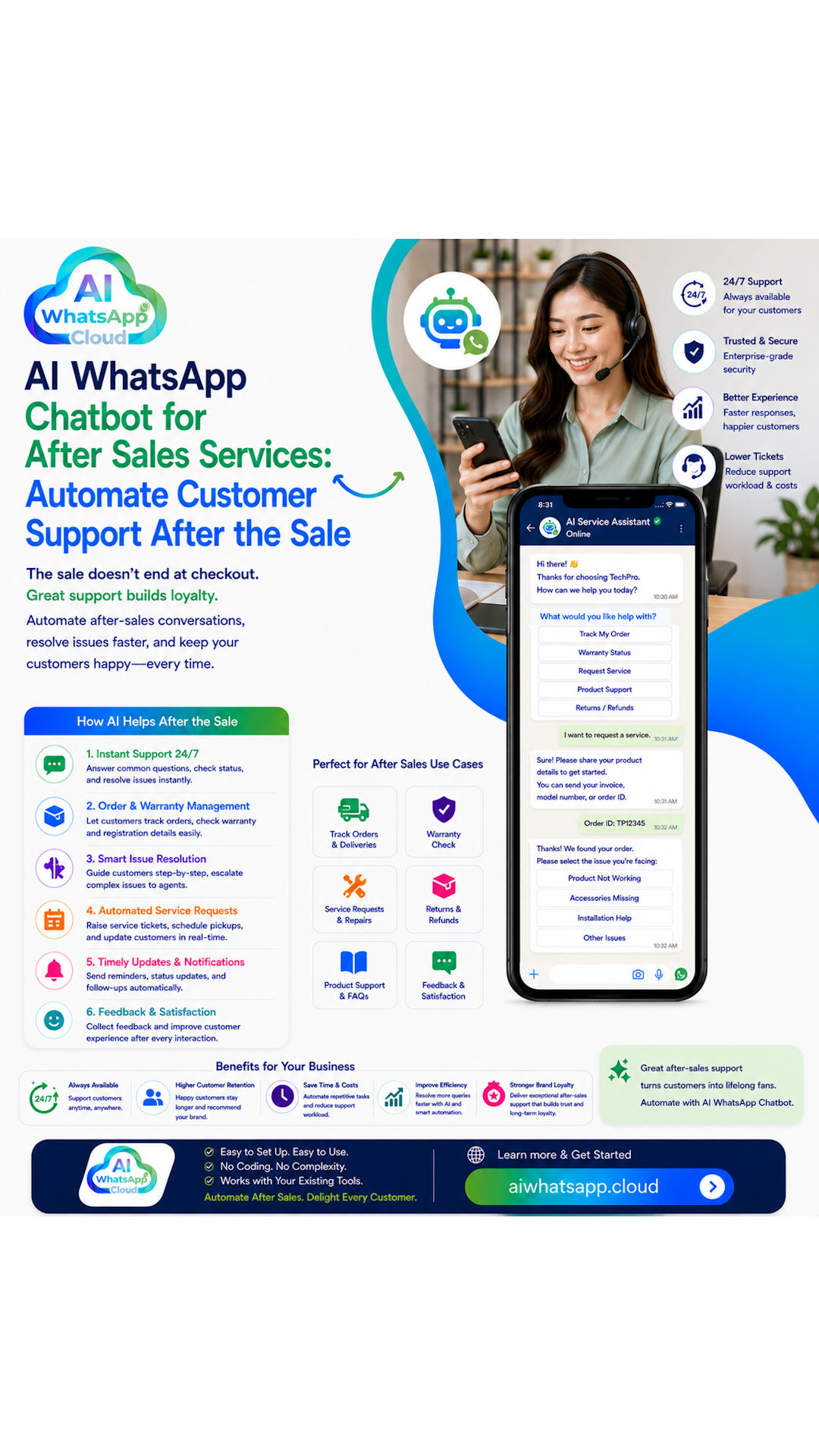
AI WhatsApp for Customer Support
Customer support is another important use case.
Customers may ask:
"Where is my order?"
"I have a problem with my booking."
"Can I change my appointment?"
"I need help with my account."
AI WhatsApp can help understand the customer's request.
Depending on the business workflow, the conversation can be:
- Answered by AI
- Routed to a specific team
- Escalated to a human agent
This is important because not every customer issue should be handled by AI.
The best AI WhatsApp Automation strategy combines automation with human support.
AI WhatsApp and Human Handover
A good AI WhatsApp system should know when a human is needed.
For example, a customer may become frustrated.
A customer may have a complex request.
A customer may need a special exception.
A customer may request a manager.
In these situations, the conversation can be handed over to the human team.
The human agent can continue the conversation with the existing context.
The customer does not necessarily need to repeat everything again.
This creates a better balance between automation and human communication.
AI WhatsApp Automation for Small Businesses
Small businesses often have limited resources.
The business owner may be responsible for sales.
The same person may also manage customer support.
They may need to answer WhatsApp messages between meetings, deliveries or daily operations.
AI WhatsApp Automation can help reduce repetitive communication.
A small business may start with simple workflows such as:
- Welcome messages
- FAQ automation
- Lead qualification
- Booking enquiries
- Follow-up
The automation can then be expanded as the business grows.
AI WhatsApp Automation for Growing Businesses
Growing businesses usually face a communication problem.
The business has more customers.
More leads are coming in.
More people are sending WhatsApp messages.
However, the communication process may still depend on the same manual system.
This can create a bottleneck.
AI WhatsApp Automation helps businesses build a more scalable communication process.
The business can automate repetitive conversations.
The team can focus on higher-value customer interactions.
AI WhatsApp Automation and CRM Workflows
AI WhatsApp becomes more powerful when it is connected to business workflows.
For example, a customer conversation may need to be connected to:
- CRM systems
- Sales pipelines
- Booking systems
- Customer records
- Marketing workflows
The exact integration depends on the business.
The important idea is that WhatsApp should not exist as an isolated communication channel.
Customer conversations can become part of a broader business process.
AI WhatsApp Automation Is Not About Automating Everything
One of the biggest mistakes businesses make is trying to automate every conversation.
This is not always the best approach.
Some conversations require empathy.
Some customers want to speak with a real person.
Some situations are too complex for a fully automated workflow.
A better approach is to identify repetitive tasks.
Then automate the tasks that create the most manual work.
For example:
Automate repetitive FAQs.
Automate initial lead qualification.
Automate basic booking enquiries.
Let human staff handle complex customer requests.
This is often a more practical AI WhatsApp strategy.
How to Start with AI WhatsApp Automation
Businesses do not need to build a complicated system from day one.
A simple starting process is:
Step 1: Review Your WhatsApp Conversations
Look at the questions customers ask most frequently.
Step 2: Identify Repetitive Work
Find the conversations that staff answer repeatedly.
Step 3: Choose One Workflow
Start with one process.
For example:
- Lead qualification
- Appointment booking
- FAQ support
Step 4: Create Approved Business Information
The AI should work with accurate business information.
Step 5: Define Human Handover Rules
Decide when a human team member should take over.
Step 6: Improve Based on Real Conversations
AI WhatsApp Automation should continue to improve based on actual customer communication.
The Future of AI WhatsApp Automation
Customer communication is moving towards more conversational experiences.
Customers do not always want to fill out long forms.
They do not always want to search through a website.
They want to ask a question.
They want an answer.
They want to complete the next step.
WhatsApp is already a natural communication channel for many businesses and customers.
AI WhatsApp Automation gives businesses a way to make these conversations more intelligent and more organised.
The future is not simply about sending automated messages.
It is about creating a customer communication workflow that can understand, respond and take action.
Final Thoughts
AI WhatsApp Automation helps businesses manage customer conversations more efficiently.
From answering FAQs and qualifying leads to booking appointments and supporting sales follow-up, AI can reduce repetitive communication work.
The most successful approach is not to replace human communication.
It is to automate the repetitive parts of the customer journey.
Businesses can let AI handle common conversations.
Human teams can focus on important customer relationships and complex requests.
If your business is still manually answering the same WhatsApp questions every day, visit AIWhatsApp.Cloud to explore how AI WhatsApp Automation can help you automate customer communication and build a more scalable business workflow.