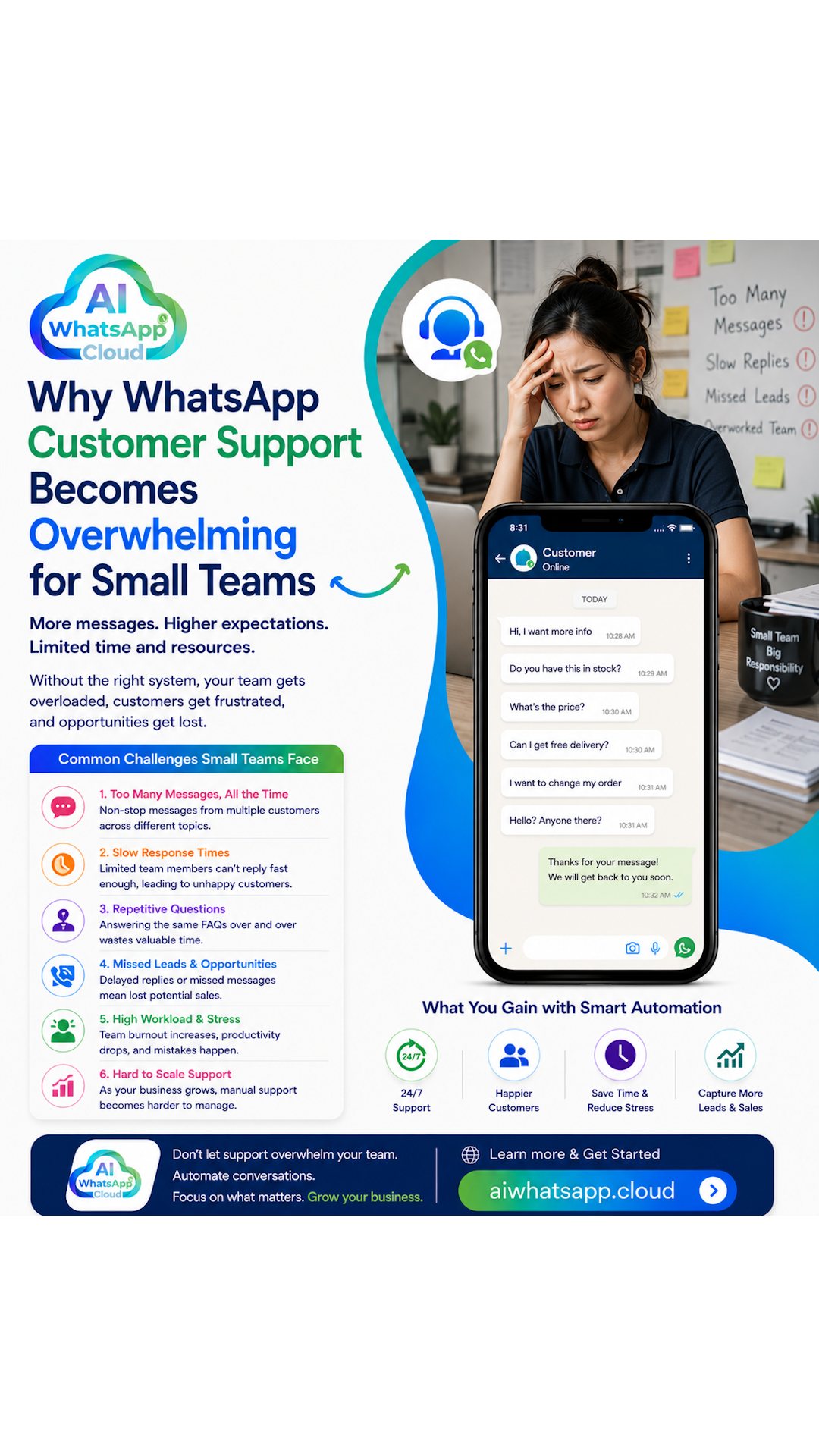
Why WhatsApp Customer Support Becomes Overwhelming for Small Teams
WhatsApp customer support often starts simply.
One person receives messages and replies when they have time.
For a small number of customers, this can work well.
The problem appears when the number of conversations grows.
The Same Questions Keep Appearing
The first sign is repetition.
Your team may spend a large part of the day answering similar questions.
The answers may be simple.
But every question still requires someone to read the message and type a reply.
Over time, this creates a significant amount of work.
Conversations Are Easy to Miss
When messages arrive continuously, important conversations can be missed.
A customer may send a message while the team is busy.
By the time someone checks WhatsApp, the conversation may be buried under newer messages.
Support Becomes Dependent on Individuals
Many small businesses rely on one person to manage customer messages.
This creates a problem.
If that person is unavailable, customer communication slows down.
The business becomes dependent on a single team member.
Manual Replies Are Difficult to Scale
Adding more messages does not always require more complex customer support.
However, manually replying to every message becomes difficult as volume increases.
This is where businesses should begin thinking about automation.
AI Can Handle Repetitive Communication
AI can help manage common customer questions.
Instead of requiring a human to answer every basic enquiry, an AI assistant can provide an initial response.
This allows the team to focus on conversations that require human judgment.
Automation Should Be Practical
The solution is not to automate everything.
Businesses should start with the most repetitive conversations.
The goal is to reduce unnecessary manual work.
Final Thoughts
WhatsApp customer support becomes overwhelming when message volume grows faster than the team's ability to respond.
The earlier a business identifies repetitive communication, the easier it is to improve the support process.
Sometimes, the best automation opportunity is hiding in the questions your team answers every day.