Online Seller WhatsApp AI Automation Case Study
For many online sellers, WhatsApp is an important customer communication channel.
Customers use WhatsApp to ask about products, prices, sizes, colours, delivery and orders.
The problem is that online sellers often handle every message manually.
In this case study, we explore how an online seller can use WhatsApp AI automation to manage repetitive customer conversations and create a more efficient customer communication workflow with AIWhatsApp.Cloud.
The Challenge: The Online Seller Could Not Automate WhatsApp
The online seller received customer enquiries throughout the day.
Customers would ask questions such as:
- "Is this product still available?"
- "What size should I choose?"
- "Do you have another colour?"
- "How much is delivery?"
- "When will my order arrive?"
- "Can I change my order?"
The questions were different.
However, many of them followed the same conversation patterns.
The seller had to manually read and reply to every WhatsApp message.
The main problem was simple:
WhatsApp communication was completely manual.
Why Manual WhatsApp Communication Becomes a Problem for Online Sellers
Online sellers need to focus on many different parts of the business.
They may need to:
- Manage products
- Process orders
- Prepare shipments
- Create marketing content
- Handle customer service
At the same time, WhatsApp messages continue to arrive.
A customer may send a simple product question.
Another customer may ask about delivery.
A third customer may be waiting for an order update.
When all conversations are handled manually, the seller becomes the communication bottleneck.
Every customer question required manual work
The seller did not have a WhatsApp automation workflow.
There was no AI system to help handle repetitive questions.
Every conversation started with a manual reply.
This made it difficult to manage a growing number of customer enquiries.
The Goal: Automate Repetitive Customer Conversations
The online seller wanted to improve the way customers were handled on WhatsApp.
The main goals were to:
- Reduce repetitive manual replies
- Answer common product questions more efficiently
- Create a more structured customer conversation
- Help customers get information faster
- Allow the seller to focus on more important conversations
The seller did not want to completely remove human communication.
The goal was to use AI to handle the repetitive work.
The Solution: WhatsApp AI Automation for the Online Seller
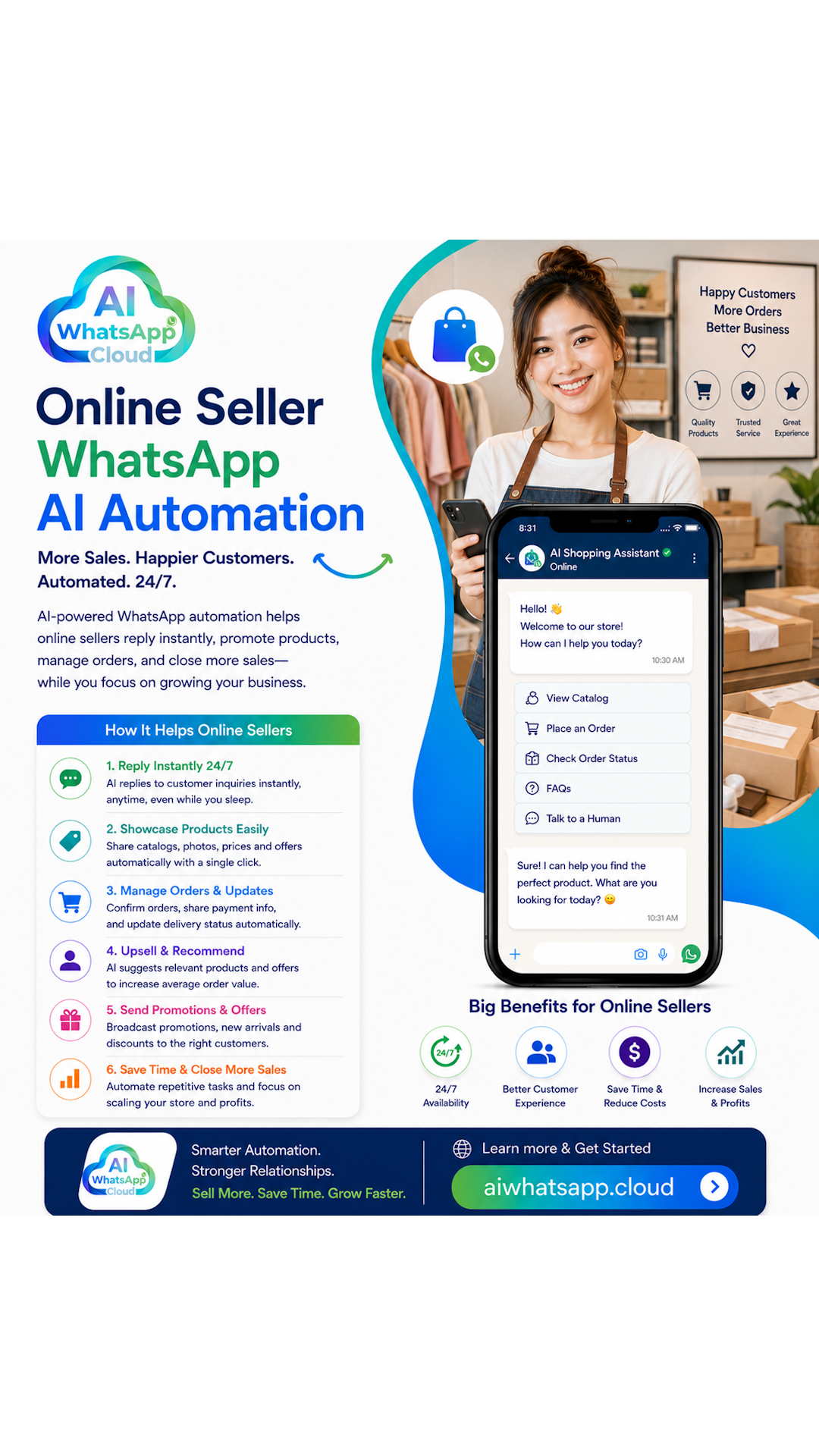
With AIWhatsApp.Cloud, the online seller can create AI-powered WhatsApp automation workflows for common customer conversations.
The AI can help manage the initial part of the customer conversation based on the information and workflows defined by the business.
Step 1: A customer sends a WhatsApp message
A customer sees a product and sends a WhatsApp message.
For example:
"Hi, is this item available?"
The conversation starts directly on WhatsApp.
Step 2: AI understands the customer enquiry
The AI can identify the general purpose of the conversation.
In this example, the customer is asking about product availability.
The conversation can then continue based on the seller's defined workflow.
Step 3: The customer receives relevant information
The WhatsApp AI workflow can guide the conversation around common customer questions.
This may include:
- Product information
- Basic product questions
- Delivery enquiries
- General order questions
- Frequently asked questions
The customer receives a more structured response instead of waiting for the seller to manually reply.
Step 4: Human support remains available
Some customer conversations require a human.
A customer may have a special request.
Another customer may have a complicated order issue.
In these situations, the seller or team can take over the conversation.
AI handles repetitive communication.
Humans handle conversations that require personal attention.
What Changed for the Online Seller?
The biggest change was moving from manual WhatsApp replies to an automated customer communication workflow.
Before automation, the seller needed to personally respond to every question.
With WhatsApp AI automation, the seller can identify repetitive conversations and create workflows around them.
Repetitive product questions can be automated
Online sellers often receive similar product questions every day.
Instead of manually replying to the same type of question, the seller can create an AI workflow for common enquiries.
Customers can be guided through conversations
AI can help create a more structured conversation.
The customer can be guided based on the purpose of the enquiry.
This is more efficient than receiving a short reply and then sending another message to ask for more information.
The seller can focus on the business
The seller does not need to spend the entire day answering repetitive WhatsApp messages.
This creates more time for product management, marketing and order fulfilment.
A Practical WhatsApp AI Automation Workflow for Online Sellers
Online sellers do not need to automate every customer conversation from the beginning.
A better approach is to start with the conversations that happen most often.
Product Questions
Customers may ask about product details, availability and basic information.
These are common conversations that can become part of a WhatsApp AI workflow.
Delivery Questions
Customers often ask about delivery information.
A structured workflow can help handle common delivery enquiries.
Order Questions
After placing an order, customers may have questions about their purchase.
The initial conversation can be guided through a defined workflow.
Frequently Asked Questions
Every online seller has questions that appear repeatedly.
These questions are often a good starting point for WhatsApp AI automation.
The Main Lesson from This Online Seller Case Study
The main lesson is simple:
The online seller did not have a customer problem. The seller had a manual WhatsApp communication problem.
Customers were already using WhatsApp.
The challenge was that every customer question required the seller to personally respond.
As the number of conversations increased, the manual process became more difficult to manage.
WhatsApp AI automation provides a way to handle repetitive communication while keeping human support available.
Is WhatsApp AI Automation Suitable for Online Sellers?
Yes.
Online sellers often receive repeated questions about products, delivery and orders.
These conversations usually follow similar patterns.
This makes online selling a practical use case for WhatsApp AI automation.
AIWhatsApp.Cloud helps businesses create AI-powered WhatsApp automation workflows for customer communication.
Final Thoughts
For an online seller, WhatsApp can quickly become difficult to manage manually.
The more customers a business receives, the more repetitive conversations appear.
Instead of replying to every message manually, online sellers can use AI to automate the conversations that happen most often.
The goal is not to replace the seller.
The goal is to let AI handle repetitive communication so the seller can focus on growing the business.
AIWhatsApp.Cloud helps businesses build smarter WhatsApp AI automation workflows.
Frequently Asked Questions
What is WhatsApp AI automation for online sellers?
WhatsApp AI automation helps online sellers automate repetitive customer conversations and create structured WhatsApp communication workflows.
Can AI answer product questions on WhatsApp?
Yes. AI can help handle common product questions based on the information and workflow defined by the online seller.
Can online sellers automate customer support on WhatsApp?
Yes. Online sellers can create automation workflows for repetitive customer support conversations and frequently asked questions.
Does WhatsApp AI automation replace customer service?
No. AI can handle repetitive communication while humans continue to manage complex customer conversations and special requests.
What can online sellers automate on WhatsApp?
Online sellers can automate common product questions, delivery enquiries, order questions and frequently asked customer conversations.
Is WhatsApp AI automation suitable for small online sellers?
Yes. Small online sellers can start by automating their most repetitive WhatsApp conversations and expand their workflows over time.