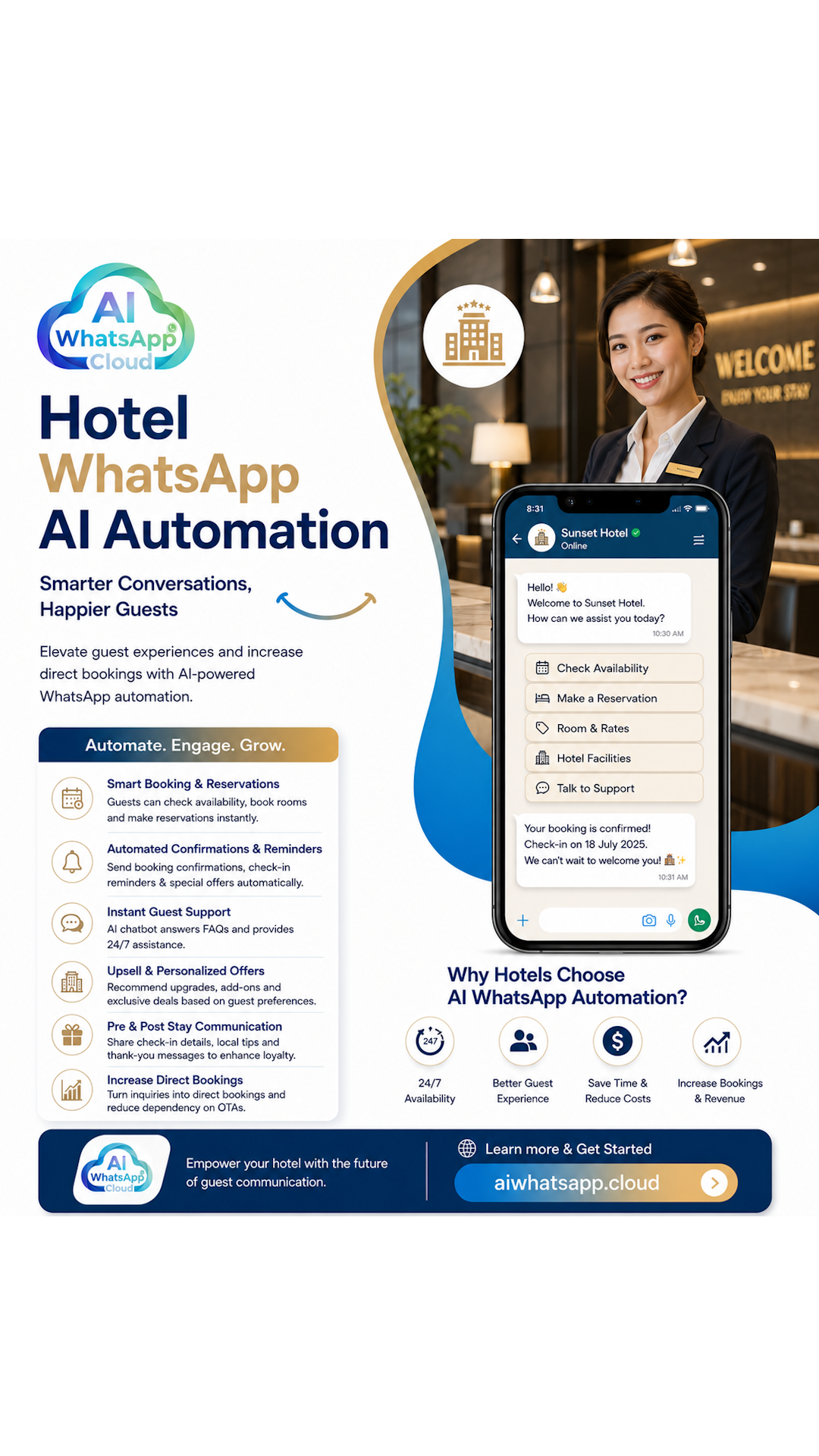
Hotel WhatsApp AI Automation Case Study: How AI Helps Hotels Handle Guest Enquiries
Hotels receive guest messages every day.
Guests ask about check-in times, breakfast, room facilities, parking, airport transfers, late check-out and many other details.
For a hotel team, these questions may seem simple.
However, when dozens or hundreds of guests ask similar questions through WhatsApp, managing every conversation manually can become a serious operational problem.
This hotel WhatsApp AI automation case study shows how AI can help hotels manage repetitive guest communication more efficiently.
The Challenge: WhatsApp Communication Was Completely Manual
The hotel was already using WhatsApp as an important communication channel.
Guests preferred sending a message instead of calling the front desk.
This created a growing problem.
The hotel team had to manually reply to almost every guest enquiry.
A typical conversation could include questions such as:
- What time is check-in?
- What time is breakfast?
- Does the hotel have parking?
- Is Wi-Fi available?
- Can I request a late check-out?
- How do I get to the hotel from the airport?
The problem was not that the questions were difficult.
The problem was that WhatsApp communication could not be automated.
The same answers had to be typed repeatedly by hotel staff.
As guest conversations increased, the front desk team spent more time answering repetitive messages and less time focusing on guests who needed personal assistance.
The Goal: Automate Repetitive Hotel Conversations
The hotel did not want to remove human support.
The goal was much simpler.
The hotel wanted to automate the conversations that did not require a human decision.
The team needed a solution that could:
- Understand common guest questions
- Provide accurate answers
- Respond automatically on WhatsApp
- Escalate more complex conversations to hotel staff
This is where AIWhatsApp.Cloud was introduced.
The Solution: AI-Powered WhatsApp Guest Communication
AIWhatsApp.Cloud was configured to help the hotel handle its most common WhatsApp conversations.
Instead of waiting for a staff member to manually reply, the AI could respond to frequently asked guest questions based on the hotel's information.
For example, a guest could ask:
"What time is check-in?"
The AI could provide the hotel's configured check-in information immediately.
A guest could also ask:
"Do you have parking?"
The AI could answer based on the hotel's available information.
This allowed the hotel to automate a large part of its repetitive WhatsApp communication.
How the Hotel WhatsApp AI Workflow Worked
The workflow was simple.
Step 1: A Guest Sends a WhatsApp Message
The guest sends a message to the hotel's WhatsApp number.
The message could be a question about the hotel, facilities or the guest's stay.
Step 2: AI Understands the Question
The AI analyses the guest's message and identifies the type of enquiry.
For example:
- Check-in information
- Breakfast
- Hotel facilities
- Parking
- General hotel questions
Step 3: AI Provides an Immediate Answer
If the question is covered by the hotel's information, the AI responds automatically.
The hotel team does not need to manually type the same answer again.
Step 4: Complex Conversations Can Be Escalated
Not every conversation should be handled by AI.
If a guest has a special request, complaint or situation that requires human attention, the conversation can be passed to the hotel team.
This creates a better balance between automation and personal service.
The Biggest Improvement Was Not Just Faster Replies
At first, the hotel expected AI to improve response times.
However, the bigger improvement was reducing repetitive work.
Before automation, hotel staff had to repeatedly answer the same questions.
After introducing AI-powered WhatsApp automation, the team could focus more of their attention on conversations that actually required human involvement.
This is an important point for hotels considering AI.
The objective is not to automate every guest conversation.
The objective is to automate the conversations that should not require a human in the first place.
Why WhatsApp AI Automation Makes Sense for Hotels
Hotels are a particularly suitable use case for WhatsApp AI automation.
Guests often ask predictable questions before and during their stay.
This makes it possible to create useful automation workflows around the guest journey.
For example, AI can help with:
- Pre-arrival questions
- Hotel information
- Frequently asked questions
- Basic guest support
- Common facility enquiries
Hotel teams can start with the most repetitive conversations and gradually expand automation over time.
The Result: A More Efficient Guest Communication Process
The hotel was able to move from a completely manual WhatsApp communication process to a more structured AI-assisted workflow.
The AI handled repetitive guest questions.
Hotel staff remained available for more complex conversations and situations that required human judgement.
The result was a more efficient way to manage hotel WhatsApp communication.
Instead of treating every WhatsApp message as a manual task, the hotel could use AI to handle the repetitive part of the process.
Final Thoughts
Hotel WhatsApp AI automation is not about replacing the front desk.
It is about helping hotel teams work more efficiently.
When AI handles repetitive guest enquiries, staff can spend more time focusing on service, guest experience and conversations that genuinely require human attention.
For hotels receiving a high volume of WhatsApp messages, the first step is simple:
Identify the questions guests ask repeatedly.
Those are often the best conversations to automate first.
AIWhatsApp.Cloud helps businesses explore practical WhatsApp AI automation for real communication problems.